When a servo axis receives a motion command but the motor stays completely dead, technicians often blame the motor first. In practice, the motor itself is rarely the root cause. Official troubleshooting literature from Mitsubishi Electric, Yaskawa and Omron consistently shows that a servo motor that “produces no torque” is usually being told not to produce torque: an enable signal that never arrived, a torque limit clamped to zero, a brake still engaged, or feedback that locks the power stage. This guide covers the causes in the order manufacturers specify, then gives a consolidated repair procedure. Replacement options for damaged motors, from the full servo motor collection, are listed at the end.

No-torque faults present in three distinct patterns; identifying the pattern saves hours. Pattern 1 — free shaft: the drive shows “ready” but the shaft can be turned by hand and offers no resistance when commanded. Mitsubishi’s MR-J4 startup manual calls this “servo motor shaft is not servo-locked” and attributes it to SON (servo-on) never being input, or 24 V DC missing from the DICOM common terminal. Pattern 2 — stiff but silent: the shaft locks when enabled, yet never moves; torque is commanded internally but blocked by interlocks such as LSP/LSN stroke-end signals. Pattern 3 — commands counted but no motion: the controller accumulates pulses while the motor sits still, pointing to mode or pulse-form mismatches.
The enable chain is the most common culprit. On a Mitsubishi MR-J4 amplifier, the motor will not servo-lock unless SON is on, RES (reset) is off, and both stroke-end signals LSP (forward) and LSN (reverse) are on. If an emergency-stop circuit, safety door switch or miswired limit switch holds any of these inputs open, the drive keeps the power stage inhibited even though the display looks normal. Omron’s official FAQ for “pulses sent but motor not rotating” lists the same sequence: verify the pulse-output indicator flashes, check control, encoder and motor cables, then confirm the drive-inhibit and deviation-counter reset inputs are not active. Yaskawa drives behave identically: S-ON must close and P-OT/N-OT overtravel inputs must release before torque is produced.
A drive can be fully enabled and still refuse to move if its torque limit is at or near zero. The MR-J4 troubleshooting manual explicitly instructs: “Check if the torque limit is 0” — parameters PA11 (forward rotation torque limit) and PA12 (reverse rotation torque limit), or the TLA analog torque-limit input when used. The startup checklist adds two more traps: internal speed commands PC05 through PC11 left at 0 in speed mode, and an analog speed command VC reading 0 V because the controller never scaled its output. Both produce a perfectly healthy drive that outputs no torque. Read actual limit and command values through the status display or tuning software, not the PLC program.
On braked motors — standard on vertical axes and Z slides — a failed 24 V DC brake supply is indistinguishable from a dead motor: the drive is enabled, the controller commands motion, but the shaft stays mechanically locked until the overload alarm finally trips. Mitsubishi’s manual lists “the brake has not released” as a primary cause of a stationary motor and directs the technician to check the brake power supply and watch for AL.99 (brake alarm). A healthy brake releases audibly 100–200 ms after servo-on. Measure the coil terminals during enable: 24 V DC present but the shaft still stuck means a worn friction disc or seized armature inside the brake assembly, requiring motor rebuild or replacement.
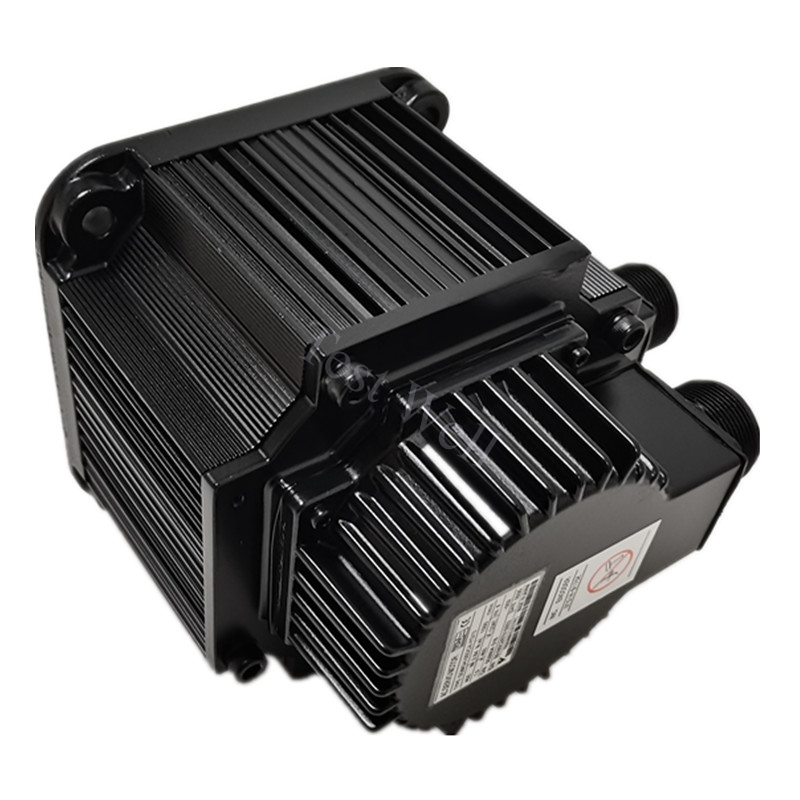
Electrical faults between drive and motor also suppress torque. Check the U/V/W power cable for broken conductors, bent or oxidized connector pins, and wrong phase order — Yaskawa’s alarm documentation ties incorrect U/V/W sequencing directly to runaway-prevention and overspeed shutdowns that leave the axis disabled. With power off, measure the three phase-to-phase resistances at the motor connector; they should be nearly equal. A 500 V DC insulation test should read comfortably in the megohm range between each winding and the frame — below roughly 1 MΩ the motor must be rebuilt. Finally, disconnect the load coupling and jog slowly: a motor that spins unloaded but stalls coupled points to a jammed ball screw or gearbox, not an electrical fault.
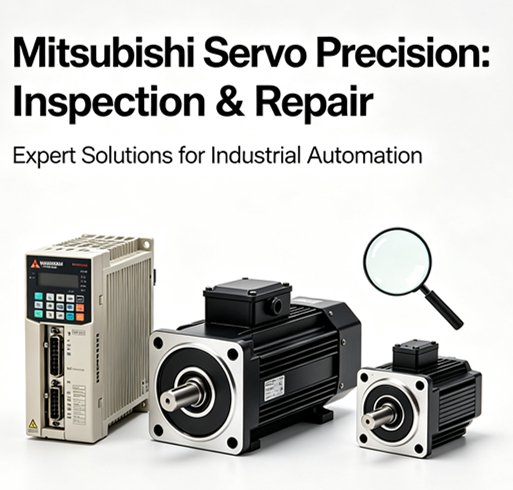
Servo drives refuse to energize the power stage when feedback is missing or implausible. Yaskawa’s Sigma-7 alarm list groups encoder backup, checksum, battery and data errors under A.810/A.820/A.830/A.840 — usually a dead absolute-encoder battery or an intermittent encoder cable — while A.C20/A.C21/A.C22 phase-detection alarms implicate the encoder or swapped motor power phases. Re-seat the encoder connector with power off, replace the battery on schedule, and verify the encoder cable is shielded, grounded and routed away from power cables. Feedback faults frequently look like “no torque with alarm LED lit,” so record the alarm code before clearing anything.

The last group is configuration. Mitsubishi’s checklist for a stationary motor covers: control mode set wrong in PA01; command pulse form not matching the controller (PA13); electronic gear mis-set; ABSM (absolute transfer mode) left on; both ST1 and ST2 off in speed mode; and bus-type MR-J4-B amplifiers mistakenly diagnosed with pulse commands when the real fault is an SSCNET III/H fiber or axis number. Yaskawa-side equivalents include wrong Pn000 mode selection and inertia ratio Pn103 set far from the true value. After parameter changes, restore defaults deliberately and re-run autotuning rather than nudging individual gains.
Work in this order — cheapest and most probable checks first:
Most no-torque conditions are preventable. Replace absolute-encoder batteries on the manufacturer’s interval, and label the axis state so re-referencing is routine. Inspect power and encoder connectors annually for oxidation, and secure cables so drag-chain flexing does not work pins loose. Exercise brake function during scheduled stops — a brake that drags today will seize within months. Keep torque-limit and mode parameters backed up with tuning software so a corrupted set can be restored in minutes. Monitor motor temperature and insulation during overhauls; catching winding degradation early converts a no-torque breakdown into a planned replacement.
If the winding insulation fails, the brake assembly is worn out, or the encoder is damaged beyond battery/connector level, replacement beats repair for uptime-critical axes. Match the original flange, shaft, taper and feedback type before ordering: the Mitsubishi HF-KP23B low-inertia servo motor suits high-acceleration positioning axes, while the Yaskawa SGMAV-C2A3A61 covers medium-inertia applications with absolute feedback. For older HC-series machines, the HC-KFS43 with brake option remains a frequently requested service motor. Feedback type, not frame size, is what usually blocks a retrofit.
Q: The drive shows “ready” but the motor is loose by hand — is the drive broken?
Usually not. That is exactly Mitsubishi’s definition of “shaft is not servo-locked”: SON is not actually input, or 24 V DC is missing at DICOM. Verify the enable signal electrically at the terminal, not just in the PLC logic.
Q: Can a low torque limit really stop the motor completely?
Yes. With PA11/PA12 at 0 (or TLA at 0 V), the drive clamps output torque below the friction needed to break the shaft free, so the motor never visibly moves and may not even alarm.
Q: How do I tell encoder failure from cable failure?
Swap-test cheaply first: re-seat connectors, replace the battery, substitute a known-good encoder cable. If the alarm persists across all three, the encoder or drive port is faulty; Sigma-7 codes A.830/A.840 with a fresh battery point to encoder hardware.
Q: The motor spins uncoupled but not coupled — what now?
The electrical loop is fine. Check ball-screw lubrication, gearbox backlash, bearing drag and coupling alignment. A jammed mechanism will surface as an overload alarm (A.710/A.720 on Yaskawa, AL.50/AL.52 family on Mitsubishi).
Q: Should I repair or replace a braked motor whose brake is seized?
Brake-only failures can be rebuilt by a motor shop, but for standard frames in current production a replacement motor is usually faster and cheaper than a teardown — confirm feedback type and shaft details first.


